A professional website is more than an online presence. It represents your brand, introduces your services, and helps potential customers decide whether to do business with you. Whether you run a small local company or a growing organization, your website plays an important role in attracting customers and generating opportunities.
One of the biggest decisions businesses face when creating a website is choosing between custom website development and a pre-built website template.
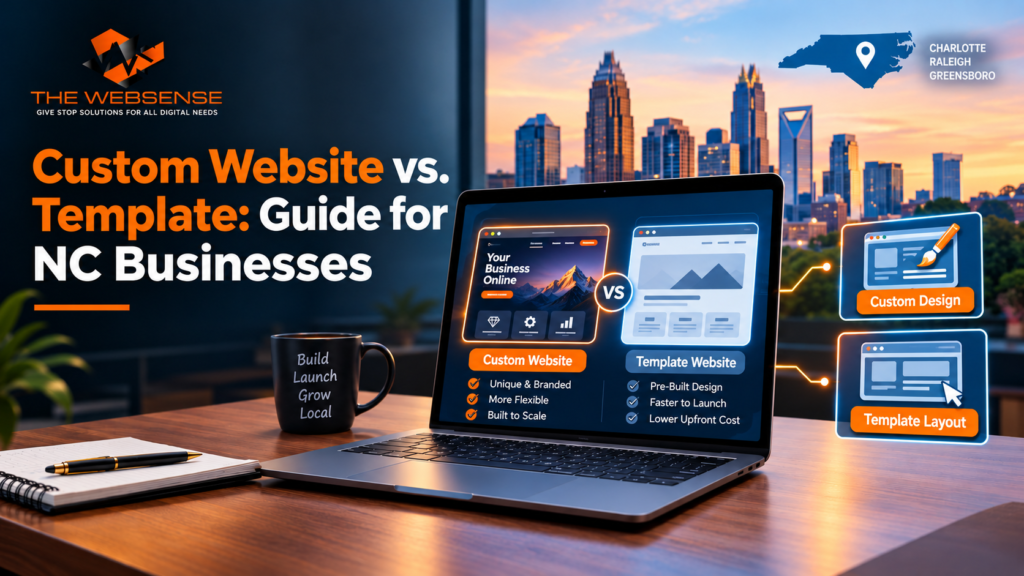
Website templates offer convenience, affordability, and a quicker setup. Custom websites provide greater flexibility, unique branding, and functionality designed around specific business requirements.
But which approach delivers better value?
For businesses in North Carolina, the answer depends on several factors, including budget, industry, customer expectations, and long-term growth plans.
In this guide, we’ll explore the key differences between custom websites and templates, their advantages and limitations, and how to choose the right solution for your business.
What Is a Website Template?
A website template is a pre-designed website layout that businesses can customize using their own text, images, colors, and branding.
Platforms such as WordPress, Shopify, Wix, and Squarespace provide templates designed for different industries, including retail, healthcare, construction, hospitality, and professional services.
Instead of designing an entire website from scratch, businesses select an existing layout and modify it to match their requirements.
For example, a local restaurant might choose a template featuring a homepage, menu, photo gallery, and contact form.
Advantages of Website Templates
Affordable initial investment: Templates generally require less design and development work, making them attractive to businesses with limited budgets.
Faster website launch: Pre-built layouts reduce the time needed to create basic website pages.
Easy content management: Many platforms include drag-and-drop editors that allow business owners to update website content without coding.
Built-in functionality: Templates may already support contact forms, galleries, blogs, and e-commerce features.
Disadvantages of Website Templates
Although templates offer convenience, they can create limitations as business requirements become more complex.
Businesses may struggle to customize certain layouts, add specialized functionality, or establish a truly distinctive visual identity.
Some templates also depend on multiple plugins or third-party extensions, increasing maintenance requirements.
However, a properly configured template can still deliver excellent results when it fits the business’s needs.
What Is a Custom Website?
A custom website is designed and developed specifically for a business rather than built primarily around an existing template.
Its structure, design, functionality, and user experience are planned according to the company’s goals and target audience.
For example, a construction company might need custom project galleries, estimate request forms, service-area pages, and integrations with customer management software.
Custom website development allows these features to become part of a coordinated digital experience.
Unlike a generic template, a custom website can be designed around the way customers interact with a particular business.
Advantages of Custom Websites
Unique brand identity: Custom designs provide greater control over typography, colors, layouts, and visual presentation.
Flexible functionality: Businesses can develop features that support their specific operations.
Scalable architecture: Developers can plan website systems around future requirements and expansion.
Tailored customer experience: Navigation, page layouts, and conversion paths can reflect actual customer behavior.
Integration opportunities: Custom websites can connect with business software, payment systems, booking platforms, and other applications.
Disadvantages of Custom Websites
Custom websites usually involve higher initial costs and longer development timelines.
They also require careful planning, professional testing, and ongoing maintenance.
For businesses with basic requirements, a fully custom solution may be unnecessary.
Custom Website vs. Template: Key Differences
Understanding the differences between these approaches helps businesses make better investment decisions.
| Feature | Custom Website | Website Template |
| Design | Unique and tailored | Pre-designed layout |
| Initial cost | Usually higher | Usually lower |
| Development time | Generally longer | Generally shorter |
| Customization | Extensive flexibility | Platform-dependent |
| Functionality | Business-specific | Often plugin-dependent |
| Scalability | Can be planned for growth | Depends on platform |
| SEO potential | Depends on optimization | Depends on optimization |
| Maintenance | Depends on implementation | Depends on platform |
Neither option is automatically superior.
The best website is one that supports your objectives, provides a positive customer experience, and remains manageable over time.
Which Option Is Better for SEO?
Search engine optimization is an important consideration when comparing custom websites and templates.
However, custom websites do not automatically rank higher on Google.
Search performance depends on factors such as content relevance, technical accessibility, website structure, usability, and overall optimization.
A well-developed template can perform effectively in search results, while a poorly optimized custom website may struggle to attract organic traffic.
1. Website Speed and Performance
Loading performance affects how visitors experience your website.
Large images, unnecessary scripts, excessive plugins, and inefficient code can contribute to slower loading times.
Custom development provides opportunities to optimize technical architecture, but templates can also perform well when properly configured.
2. Mobile-Friendly Design
Customers frequently browse websites using smartphones.
Both custom and template-based websites should provide responsive layouts, readable content, accessible navigation, and functional forms.
A mobile-friendly experience helps visitors explore your services regardless of their device.
3. Content Optimization
High-quality content remains essential for attracting relevant search traffic.
Service pages should explain what your business offers, answer customer questions, and provide clear next steps.
Businesses can also publish educational articles that address common industry problems.
4. Technical SEO
Important technical elements include descriptive URLs, appropriate heading structures, crawlable internal links, and accurate page metadata.
Both website approaches can support these requirements.
For businesses seeking professional assistance, The WebSense provides SEO services in North Carolina to help improve website optimization and search visibility.
When Should You Choose a Website Template?
A website template may be suitable when your business needs a straightforward online presence without complex functionality.
Templates are often appropriate for startups, freelancers, small service providers, and businesses with limited initial budgets.
Consider using a template when:
- You need to launch your website quickly.
- Your budget is relatively limited.
- Your website requires standard pages and features.
- You prefer managing content through a visual editor.
- You do not need extensive third-party integrations.
For example, a freelance consultant might only require a homepage, service descriptions, testimonials, and a contact form.
A professionally configured template could meet these requirements without additional development complexity.
However, businesses should consider whether their chosen platform can support future changes.
When Should You Invest in Custom Website Development?
Custom development becomes more valuable when a website plays a central role in business operations, customer acquisition, or online sales.
Your Business Requires Specialized Features
Some companies need functionality that standard templates cannot easily provide.
Examples include customized booking systems, client dashboards, membership platforms, advanced product configuration, and complex payment workflows.
Custom development allows these features to be designed around specific business processes.
Your Brand Needs a Distinctive Appearance
Businesses operating in competitive industries often benefit from a memorable digital identity.
Custom design provides greater freedom to create unique layouts, interactive elements, and visual experiences that reflect brand positioning.
You Plan to Expand Your Business
Growing companies may eventually need additional services, integrations, customer portals, or e-commerce capabilities.
A custom website can be planned with those future requirements in mind.
Your Website Supports Important Business Operations
For organizations relying on website-generated leads, reservations, or transactions, usability and functionality are especially important.
Custom development can create more tailored customer journeys and reduce unnecessary steps.
Explore The WebSense’s website development services in North Carolina to learn about business-focused development solutions.
How Much Does a Custom Website Cost Compared to a Template?
Website development costs depend on the complexity of the project rather than the design approach alone.
Template-based websites often have lower upfront costs because their layouts and basic functionality already exist.
However, businesses may still need to pay for hosting, premium plugins, platform subscriptions, customization, and ongoing support.
Custom websites usually require additional investment in planning, UI/UX design, development, integrations, and testing.
Several factors influence the final cost:
- Number of website pages
- Complexity of design requirements
- Custom features and integrations
- E-commerce functionality
- Content development
- Security and maintenance requirements
Instead of comparing only initial prices, businesses should evaluate long-term ownership costs.
A lower-cost website may become expensive if significant modifications are required later.
Similarly, a custom website may not justify its investment if the business only needs basic functionality.
The goal is to choose a solution that provides practical value.
Five Questions to Ask Before Choosing Your Website
Before deciding between a custom website and a template, consider the following questions.
1. What Is Your Primary Website Goal?
Determine whether your website should generate leads, sell products, accept bookings, showcase projects, or provide business information.
2. Who Is Your Target Audience?
Understanding customer needs helps determine the most suitable layout, content, navigation, and functionality.
3. What Is Your Available Budget?
Consider both development expenses and ongoing costs, including hosting, security, updates, and support.
4. Will Your Website Need Additional Features?
Think about future requirements such as online payments, customer accounts, integrations, or expanded product catalogs.
5. Who Will Manage the Website?
Choose a solution your team can maintain efficiently, whether through a content management platform or professional development support.
These questions can help prevent unnecessary spending and ensure your website supports your long-term objectives.
Why Choose The WebSense for Web Design in North Carolina?
Creating an effective business website requires more than choosing an attractive design.
It involves understanding your customers, developing a clear content structure, and building an experience that encourages meaningful interactions.
At The WebSense, we focus on understanding each business’s goals before developing its digital experience.
Our approach combines design, development, and digital marketing to help businesses establish a stronger online presence.
Rather than treating every project as identical, we consider the specific requirements, challenges, and objectives behind each website.
Whether you’re planning a new website or improving an existing one, our web design services can help you explore solutions suited to your business.
Ready to Build a Website for Your Business?
The WebSense helps businesses in North Carolina explore professional website design and development solutions tailored to their goals.
Whether you need a new website, a redesign, or advanced functionality, our team can help you evaluate your options.
Get a Free Quote and take the next step toward building your digital presence.
Final Thoughts
Choosing between a custom website and a website template is an important decision for any business building its online presence.
Templates provide affordability, convenience, and faster setup, making them useful for businesses with straightforward requirements.
Custom websites offer greater control, flexibility, and opportunities to develop functionality around specific business needs.
Neither approach guarantees better search rankings, conversions, or revenue.
What matters most is selecting a website solution that aligns with your customers, business objectives, and future plans.
Frequently Asked Questions
Is a custom website better than a WordPress template?
Not always. WordPress supports both custom websites and template-based designs. The better choice depends on your required features, budget, and customization needs.
Can website templates rank well on Google?
Yes. Template-based websites can achieve strong organic visibility when they provide helpful content and meet relevant technical SEO requirements.
How long does custom website development take?
Development timelines depend on project complexity, design requirements, integrations, content availability, and testing.
Can I upgrade a template website later?
Yes, although the available customization options depend on the platform and existing technical architecture. Some upgrades may require partial or complete redevelopment.
Is custom website development worth the investment?
Custom development can be valuable when a business needs specialized functionality, greater design flexibility, or a website architecture suited to long-term growth.